



















I recently attended the launch of the “Martech for 2026” report and one statistic stood out: When asked about the biggest challenge in deploying AI across marketing platforms, 56.3% of respondents cited poor data quality. Not budgets. Not technical capability. B2B Data quality.
But that single number highlights a deeper issue. This isn’t just a data problem. It’s an architectural one. The report predicts major consolidation and transformation across the martech landscape because AI simply cannot operate in isolation. If your platforms aren’t connected and your data isn’t clean, even the most advanced AI will fall short.
For B2B marketers, this problem is even obvious. Our buyer journeys stretch across months, sometimes years. Multiple stakeholders join and re-join at different points. They move across channels quickly, bringing new context each time. If your systems can’t adapt, you lose the narrative.
Yet most organisations still run these journeys on platforms that don’t talk to each other, and that fragmented architecture is fundamentally incompatible with effective AI.
Quick answer:
B2B marketers must unify their data and integrate platforms because fragmented systems undermine AI, break customer journeys, and cost revenue – while connected architecture enables clean data, coordinated experiences, and real growth.
The Hidden Cost of Fragmentation
Disconnected systems have a real cost. B2B journeys aren’t linear. Someone might attend a webinar in March, read a case study in June, and only engage with sales in September. Meanwhile, three other colleagues might follow completely different paths.
When your systems are siloed, this picture becomes impossible to see. Your website logs behaviour; your CRM stores contact data; your marketing automation tracks email; your event platform logs attendance; and product usage sits somewhere else entirely.
Without integration, none of it connects.
You end up with different versions of the truth across different teams. Gaps appear in lead and account data and messaging becomes inconsistent because one system doesn’t know what another has delivered. Sales handoffs lose context and duplicates spread. Every new platform that’s added without a clear integration strategy increases the complexity and disconnect.
The impact is clear.
Teams use only a fraction of the capability of their tools. Journeys feel disjointed. Marketing loses visibility on performance. Prospects receive mixed messages. Scoring models fail. Attribution breaks. Sales and marketing operate from separate realities. By the time the issue reaches pipeline and revenue, the damage has already happened.
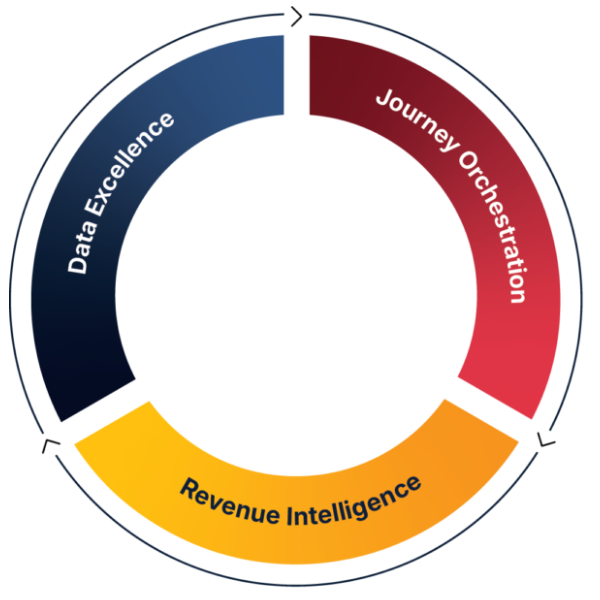
JTF Revenue Acceleration Loop
Building Around the Revenue Acceleration Loop
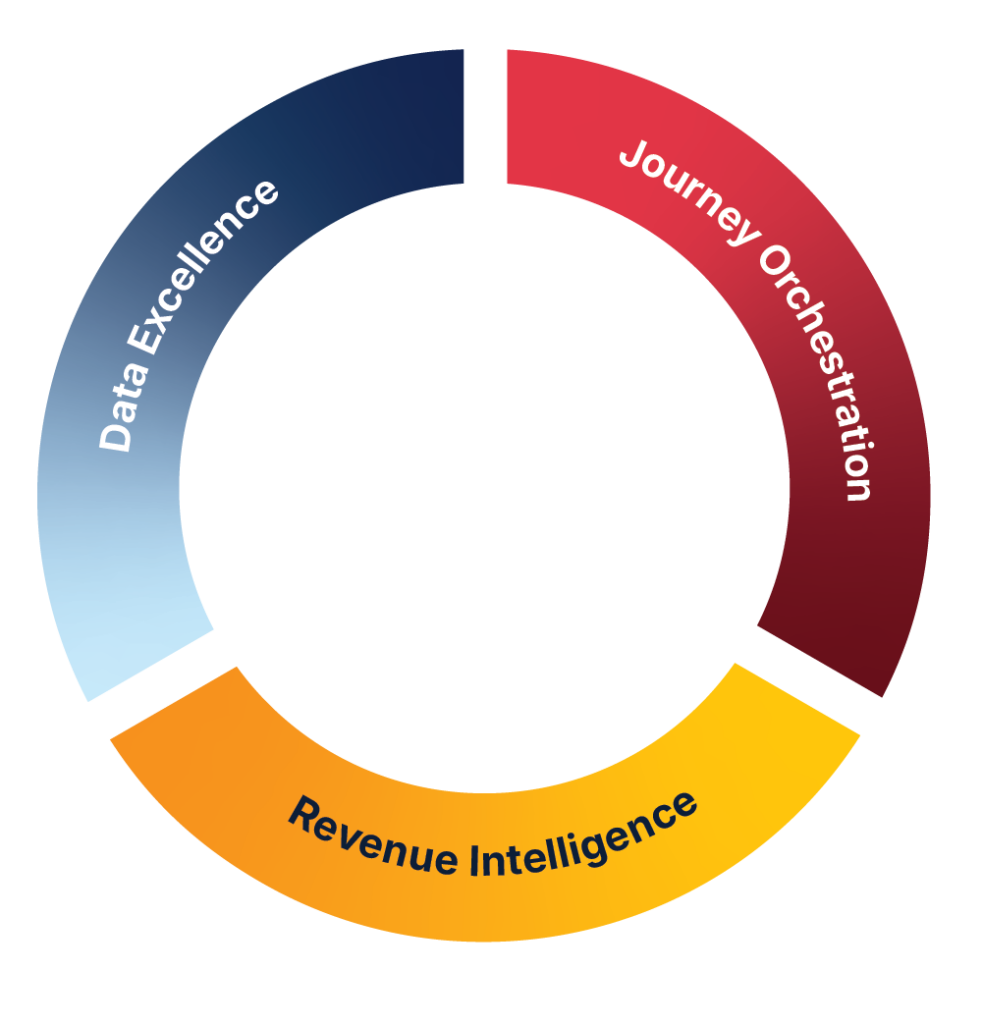
This is where JTF’s Revenue Acceleration Loop becomes essential. The framework centres on three connected pillars: data excellence, journey orchestration, and revenue intelligence.
- Data excellence is about creating one reliable version of the truth.
- Journey orchestration uses that data to deliver coordinated experiences.
- Revenue intelligence measures impact and feeds insight back into the loop.
All three depend on integrated systems. Data excellence needs connected platforms. Journey orchestration relies on real-time data flows. Revenue intelligence requires complete attribution. The loop only accelerates when the infrastructure beneath it is unified.
How Adobe’s Architecture Supports the Loop
Adobe’s B2B ecosystem is built on this idea. At the centre is Adobe Real-Time CDP (B2B Edition). This is where data excellence becomes operational.
The CDP brings together CRM data, behavioural signals, campaign responses, product activity, and offline interactions. It resolves identities at both person and account level (which is crucial in B2B where accounts often have complex structures), multiple regions, and varied buying groups. The CDP maps people accurately and keeps that view consistent throughout the lifecycle.
Adobe Experience Platform sits beneath the CDP, and:
- provides governance, schema standardisation, and data quality controls,
- prepares organisations for real-time activation and reduces the operational cost and risk of running disconnected systems,
- becomes the data foundation that everything else relies on.
Once the foundation is in place, journey orchestration becomes achievable.
Marketo Engage remains the core automation engine. It manages scoring, lifecycle flows, nurtures, and multi-channel programmes. But when Marketo operates from a unified data layer instead of narrow email interactions, the quality of journeys changes. You can trigger programmes from intent signals, account-level activity, and enriched profiles.
Adobe Journey Optimiser B2B Edition adds real-time orchestration. It responds instantly when someone books a demo, views pricing, or engages with high-value content. Journeys shift based on what’s actually happening. Messaging across email, web, ads, and sales becomes coordinated instead of disconnected.
Personalisation becomes more accurate because it’s based on a full context, not isolated lists. You know where people sit in the buying group, what they’ve engaged with, and what stage the overall account is in. That level of insight drives performance.
Where AI Changes Everything
This is where revenue intelligence completes the loop and where AI delivers real value.
Adobe’s agentic AI capabilities work across the whole stack. They’re not confined to a single product or silo. Because the B2B data is unified, AI can analyse patterns across all channels, prioritise leads based on behaviour, score accounts using signals from multiple systems, and recommend content based on real context. It acts, not just observes.
AI cuts through complexity. It accelerates decision-making. It flags issues early. It removes manual work by refining scoring, generating content variations, and automating routing. When combined with Adobe Experience Manager for content delivery, the entire stack becomes an optimisation engine.
The difference here is that Adobe’s AI doesn’t sit in a silo. It works across the entire customer journey; interprets data holistically; recommends next-best actions that reflect the full picture and optimises in real time because the underlying data flows in real time.
This only works when systems are integrated. Without integration, AI returns incomplete signals and makes limited decisions.

Insights that matter
Guide to unlocking the AI potential in B2B Marketing
We’ve developed a guide to help marketing leaders cut through the noise and identify where AI can actually deliver results – faster lead conversion, smarter targeting, better use of data, and improved ROI.
What This Means for Modern B2B Marketers
The move from siloed platforms to unified journeys is no longer optional. It’s the foundation that determines how well you can grow.
You need a unified data foundation as a priority, not a long-term aspiration. You need to map journeys across the full lifecycle so the gaps become visible. You need teams aligned around shared outcomes, not channel metrics. You need clear measurement of pipeline influence. And you need AI embedded across your operations, not bolted onto one system.
This is the shift from fragmented activity to a Revenue Acceleration Loop that compounds value. Teams that achieve this move faster, communicate more clearly, and deliver experiences that match real customer needs.
The martech landscape is heading toward consolidation. The platforms that succeed will be those that prioritise integration and open architecture. The organisations that thrive will be those that build around unified data.
Silos cost revenue. Unified journeys unlock it. Integration is now the foundation that everything else depends on.
Conclusion
B2B marketing cannot thrive on fragmented systems. Poor B2B data quality and disconnected platforms block AI, break journeys, and cost revenue.
The solution is integration. A unified data foundation enables clean insights, coordinated experiences, and real-time intelligence.
Frequently Asked Questions
Poor data quality and disconnected systems, not budgets or technical capability.
Because journeys are long and complex, siloed platforms create gaps, inconsistent messaging, and lost context.
A framework built on three pillars – data excellence, journey orchestration, and revenue intelligence – that depend on integrated systems.
By unifying data through Real-Time CDP and Experience Platform, then enabling coordinated journeys with Marketo Engage and Journey Optimiser.
Integration is no longer optional – silos cost revenue, while unified B2B data and connected journeys unlock growth.