




















The invisible leak in your marketing engine
As organisations invest in automation, generative AI, agents, and increasingly sophisticated orchestration tools, the actual data feeding these platforms are quietly falling apart. It’s a familiar story: teams pursue the latest technology whilst the core system holding their campaign and measurement data deteriorates.
For most MOps leaders, the reality is that your MarTech engine looks powerful on the outside, but it’s silently leaking budget and capacity. In B2B, contact and account data degrades annually. People change jobs. Companies merge or fold. Buying groups evolve. When you don’t keep pace with that level of change, everything downstream from segmentation, scoring, routing, and attribution becomes less reliable and more expensive to run.
Poor data quality is a strategic issue that undermines your reporting credibility, weakens demand generation outcomes, and obscures the true ROI of marketing spend. Worse still, it could mean that you’re overpaying on platform databases or licences and wasting budget on targeted campaigns built on lists that are out of date.
Quantifying the cost of dirty data
Quantifying the cost of dirty data
Understanding where poor data hygiene hits hardest helps you build a compelling internal business case. Three areas typically reveal the most tangible losses: licensing waste, campaign failure, and productivity drain.
Licensing Waste
In enterprise MarTech stacks, platform costs scale with the volume of records you’re storing. Duplicate contacts, obsolete leads, fragmented account hierarchies, all inflate your Salesforce or Adobe Marketo Engage database. Your licensing fees climb, not because you’re engaging more genuine leads (prospects, customers, leads and contacts), but because redundant, unmarketable records are taking up space. These “ghost” records represent budget that could be freed up and put to better use, yet they sit there long after they’ve stopped being relevant.
Campaign Failure
Poor data quality also shows up clearly in campaign performance. High bounce rates, elevated spam complaints, inconsistent segmentation stem from unresolved data problems. Invalid or outdated contact information distorts your targeting, dilutes message relevance, and damages your sender reputation. Over time, the cumulative effect suppresses engagement, obscures genuine performance, and makes it nearly impossible to interpret how well you’re performing. You’re left with sub-optimal campaign results that knock-on to future campaigns that add to the inability to measure ‘Marketing’ with any confidence.
Productivity Drain
Then there’s the productivity cost, which rarely appears on any balance scorecards but is deeply felt by MOps teams. Hours are routinely spent cleaning lists, correcting field formats, reconciling conflicts across systems, and preparing data for campaigns. This work consumes time that should be dedicated to strategy, optimisation, or innovation. Instead of focusing on high-impact activities, teams find themselves in a cycle of repetitive, low-value tasks that kill a team’s morale and hold back growth and scalability.

Turn hygiene into performance
Make Your Data Work Harder
Strong data hygiene cuts waste, sharpens targeting, and gives your MarTech stack the clarity it needs to perform. Our Data & Analytics services help you get there with focused audits, governance, and ongoing hygiene that keeps your database lean and your budget working harder.
From chaos to clarity: a usecase
The strategic value of tackling data quality becomes clearer when you look at what actually happens in a go-to-market motion. Take a mid-market SaaS company that launches an account-based marketing strategy to accelerate pipeline growth. They have what appears to be an accurate target account list and strong intent signals flowing through digital channels. The expectation is improved conversion rates. Instead, MQL-to-SQL performance flatlines.
A review of the data reveals that roughly 30% of their target accounts contained outdated job titles, fragmented contact records, and multiple duplicates linked to the same buying groups. This means nurture streams are being delivered to the wrong audiences, undermining relevance and dampening conversion signals.
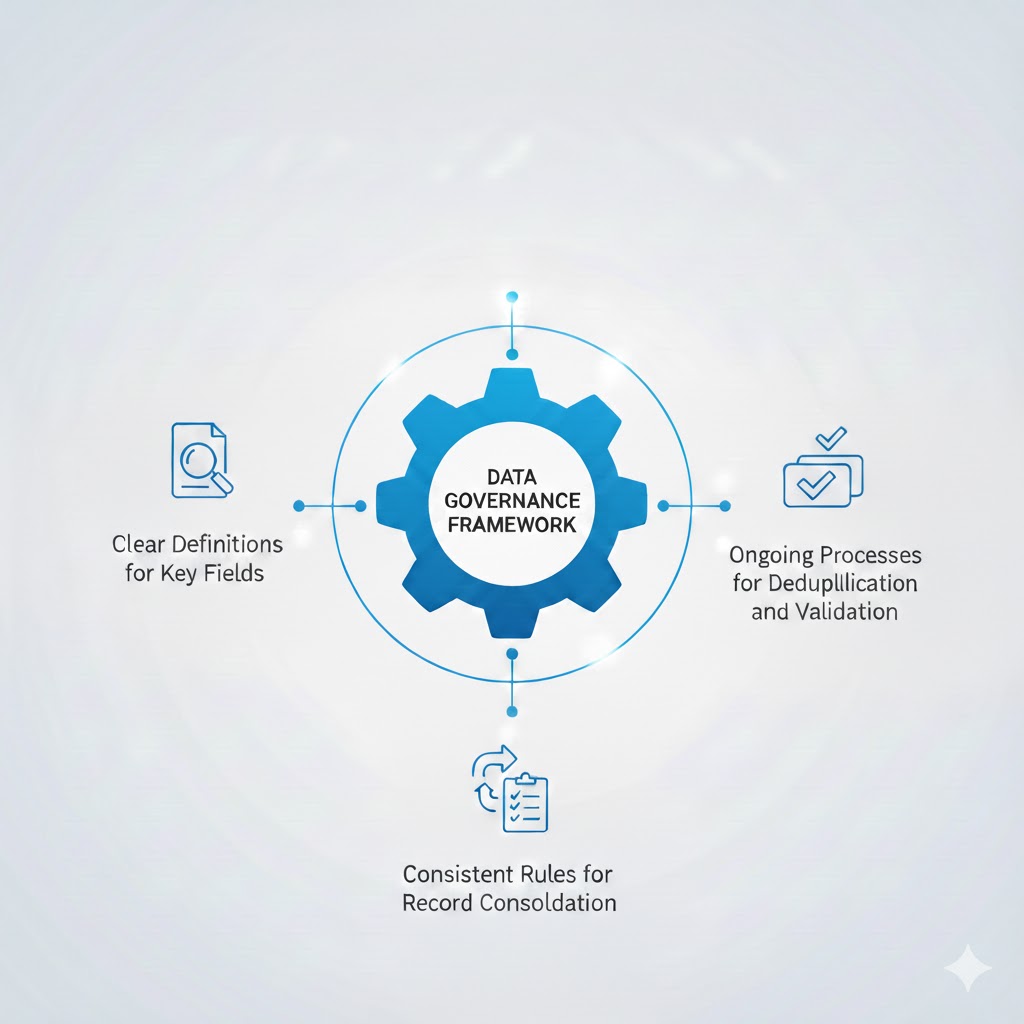
The fix doesn’t require a bigger budget or complex tools. The organisation implements a standardised data governance framework: clear definitions for key fields, consistent rules for record consolidation, and ongoing processes for deduplication and validation.
And the impact is measurable. Within a quarter, they could see a 15% increase in MQL-to-SQL conversion without increasing media spend. The lift comes not from doing more, but from having greater clarity and trust in their data foundation. This enables the team to prioritise accounts with confidence, drive alignment with sales, and produce reporting that sales partners trusted.
Strategic pillars of data governance
Effective data governance relies on high-level principles that transform data from a liability into an asset.
The first is normalization. Consistent definition and application of values across critical fields. For segmentation and routing to function reliably, variations like “USA,” “US,” and “United States” need to be standardized to a single authoritative value that all systems recognise. Normalization ensures that rules applied in one part of the stack translate accurately in others, enabling coherent execution across the board.
The second is deduplication logic that goes beyond basic matching. Identifying duplicate records properly requires a multi-attribute approach that considers combinations of identifiers like role information, account associations, and behavioural ties. A deduplication methodology grounded in business logic, rather than simple matching, gives a business a far more accurate and actionable unified customer view. This unified view supports segmentation, journey orchestration for a buying group, and measurement with much greater precision.
The third is enrichment. Whilst internal sources provide the structural backbone of your database, third-party enrichment tools can fill gaps that internal processes can’t. For example Industry classification, revenue ranges, updated contact roles. Enrichment needs to be targeted and tied to clearly defined ideal customer profiles (ICPs), rather than applied indiscriminately, to avoid adding noise in your database. When implemented properly, enrichment improves scoring models, sharpens prioritisation, and strengthens audience definition.
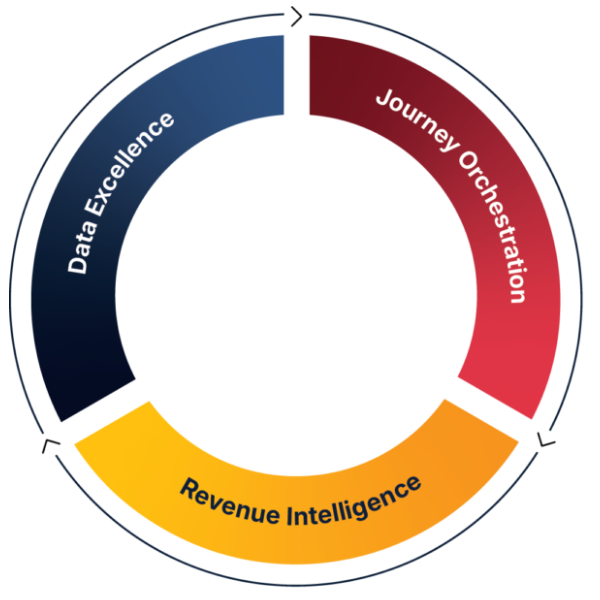
JTF Revenue Acceleration Loop
Closing the Loop on Revenue Acceleration
When your data is clean, governed, and consistently structured, every stage of the revenue acceleration loop moves faster. Targeting sharpens, handoffs tighten, scoring becomes more predictive, and attribution finally reflects reality. Instead of fighting friction at each stage, your go‑to‑market engine compounds momentum – turning data hygiene from a maintenance task into a direct driver of pipeline velocity and revenue confidence
From defending performance to explaining outcomes
Improved data quality fundamentally changes how marketing operations are perceived within the organisation. When your CMO or CFO asks for ROI details from a campaign, a governed and reliable dataset allows you to respond with accuracy, alignment, and confidence. Conversations shift from defending numbers to explaining outcomes and strategy.
This shift in credibility has implications for how MOPs are seen in a business. Rather than being seen as the team that fixes lists and resolves issues, marketing operations becomes the function that guards investment, accelerates execution, and underpins revenue-connected decision-making. Accurate, integrated data provides the foundation for advanced attribution, meaningful performance measurement, and confident adoption of AI-enabled capabilities that depend on trustworthy inputs.
Investing in data hygiene should be positioned as reclaiming wasted budget and optimising assets, not incurring a cost. Each duplicate resolved, each field normalised, each automated validation rule put in place reduces licence pressure, improves segmentation, and frees operational capacity. These gains are cumulative and persistent, delivering value over time rather than requiring continual reinvestment.
Is your data working for you, or against your budget?
Your MarTech stack is only as powerful as the data flowing through it. AI, orchestration, automation, all of these depend on a stable, trusted foundation. Without that foundation, complexity increases whilst performance stalls. With it, execution becomes sharper, reporting more credible, and strategic conversations actually possible.
Data hygiene isn’t a dull MOPs task. It’s a strategic investment that directly impacts budget optimisation, campaign performance, and organisational influence.
The question isn’t whether data hygiene is necessary. The question is whether you’re consistently reconciling inconsistent metrics, defending assumptions in executive meetings, or losing confidence in what you’re measuring. If you are, it’s time to strengthen the foundation. Building that foundation enables confident planning, reliable reporting, and a clear path to sustained, measurable impact on revenue and growth.
Schedule a consultation to see how we can help you quantify your data decay and identify the immediate steps you can take to improve your campaign ROI.
Frequently Asked Questions
Clean, standardised data removes friction at every stage – from targeting and scoring to handoff and attribution – allowing momentum to build instead of stall
When records are outdated or inconsistent, segmentation breaks, routing misfires, and sales receives low‑quality signals. Every correction adds delay, dragging down conversion speed.
Governance ensures that fields, values, and processes stay aligned across systems, so your GTM teams operate from a single, trusted source of truth that speeds decision‑making.
With accurate account and contact data, both teams see the same buying groups, the same signals, and the same priorities — reducing friction and tightening handoffs
Yes. By eliminating waste, improving targeting, and strengthening scoring accuracy, clean data increases conversion efficiency — creating lift without adding budget